

A slipped disc refers to an intervertebral disc of the spine that has lost its normal shape and/or consistency. The altered shape occurs when the disc’s soft inner material (nucleus pulposus) bulges or leaks out of its external fibrous covering (annulus fibrosus).1 Several medical terms, such as herniated, ruptured, torn, bulged, or protruding disc may be used interchangeably with a slipped disc.
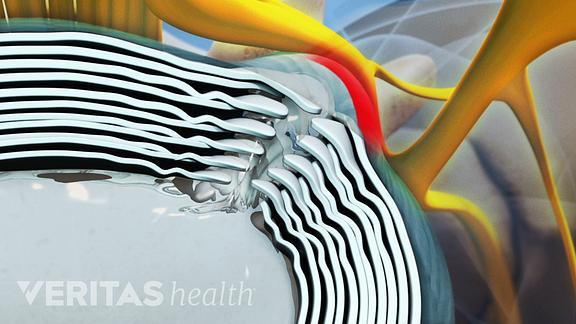
A herniated disc occurs when material from a disc's inner core leaks out. Watch: Herniated Disc Video
Your intervertebral discs are spinal shock absorbers and help transfer loads evenly. When a slipped disc occurs, the entire motion segment—including the adjacent vertebrae, connective tissue, blood vessels, and nerves may be affected.2 Slipped discs are more common in the lower back, followed by the neck.3
How a slipped disc occurs
The two most common causes for a slipped or herniated disc are3:
- Natural degeneration of the disc, which causes the nucleus pulposus to become less hydrated and weaken with age.
- Trauma to the disc, which may occur due to lifting a heavy load using incorrect posture or from external forces, such as, a whiplash injury.
Rarely, disorders of the connective tissue of the spine or alterations in the shape of the spinal vertebrae, such as short pedicles, may cause a slipped disc to occur.3